I'm Learning How to Build a Faceless AI YouTube Channel (And You Can Follow Along)
Is the AI YouTube gold rush a sustainable business or just a shortcut to a shadowban? I’m putting my own time and money on the line to test the "faceless channel" model for 90 days, documenting every tool, cost, and metric along the way.
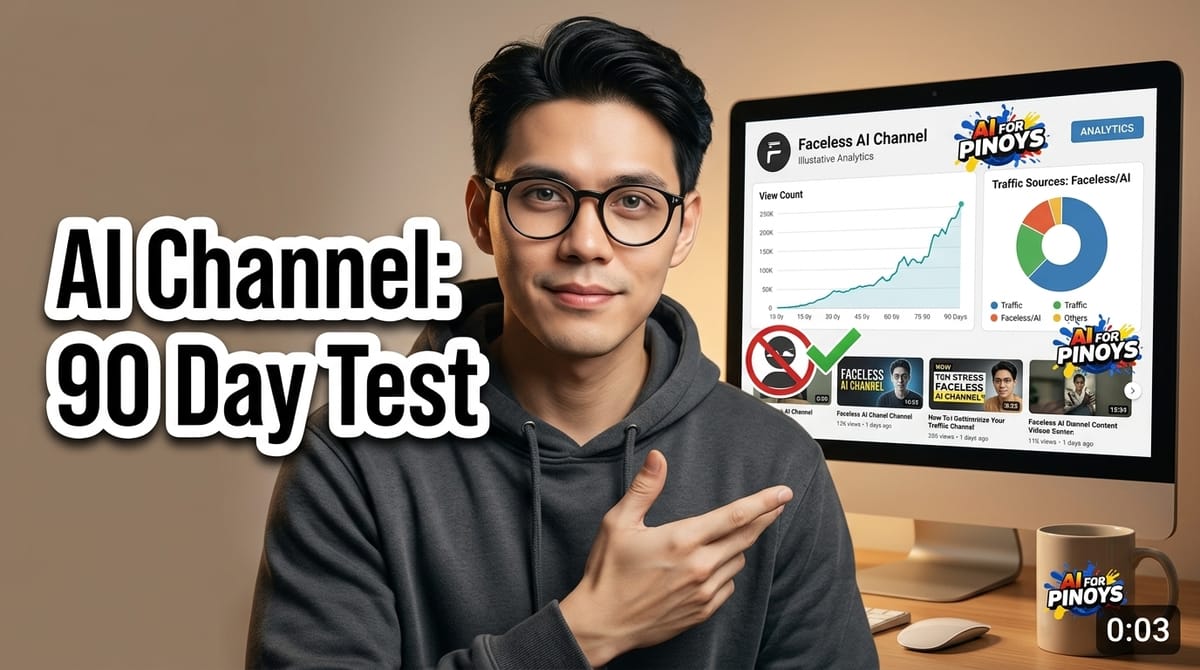
Hey, it's G.
So I've been seeing these faceless AI YouTube channels everywhere. People starting from zero, posting AI-generated videos, getting monetized within a month, making $3K+.
And honestly? I'm skeptical but curious.
Is this real? Is it sustainable? Can someone like me - who's never run a YouTube channel seriously - actually make this work?
I don't know. But I'm going to find out.
This isn't a "follow my proven system" post. This is a "I'm figuring this out as I go and documenting everything" experiment.
If it works, you'll see exactly how. If it fails, you'll learn from my mistakes without wasting your own time.
Let's do this.
Why I'm Trying This (And Why You Might Want To)
The appeal:
- 100% AI-generated content (cheap to produce)
- No showing face (perfect for introverts like me)
- Can be outsourced to VAs (scalable if it works)
- Potential passive income (if you crack the code)
My skepticism:
- Everyone's doing this now (is it too saturated?)
- YouTube might crack down on AI content (risky long-term)
- Quality vs. quantity problem (will viewers actually watch?)
- Shadowban risks (I'll explain this later)
My goal: Test this for 90 days. Post consistently. Track real numbers. Share everything I learn.
No hype. No guarantees. Just an honest experiment.
The Big Warning: Shadowbans (And How I'll Try to Avoid Them)
Apparently, one of the biggest problems with new YouTube channels is getting shadowbanned.
What that looks like:
- You post a video
- It gets 11 impressions
- All impressions are from YouTube search only
- Zero homepage recommendations
- Basically, YouTube thinks you're a bot
How I'm trying to avoid this:
I'm using an old Gmail account I've had for years. Not creating a new one specifically for this channel. The theory is that YouTube trusts older accounts more than brand new ones.
Also, I won't change the branding (profile picture, channel name, banner) until I see consistent traffic from at least 4-5 videos. I've read that changing everything at once can trigger shadowbans.
Not sure if this is true, but I'd rather be cautious than restart from zero.
My Experiment Plan: Week by Week
Here's how I'm structuring this 90-day test:
Week 1-2: Setup and First Video
- Choose a niche (I'm thinking AI tools or productivity)
- Study competitor channels
- Create first script with Claude
- Generate voiceover with 11 Labs
- Create visuals with Leonardo AI
- Edit everything in CapCut
- Post and track results
Week 3-6: Consistency Test
- Post 2-3 videos per week
- Track views, impressions, watch time
- Test different video lengths
- Experiment with thumbnails and titles
- Document what's working vs. what's flopping
Week 7-10: Optimization
- Double down on what's working
- A/B test different formats
- Try different AI voice styles
- Experiment with video pacing
- See if I'm getting any traction yet
Week 11-12: Outsourcing Test
- If this is working, try hiring a VA
- Document the handoff process
- See if quality stays consistent
- Calculate actual costs vs. potential revenue
The Actual Process I'll Be Testing
Let me walk you through what I'll be doing for each video. This is based on what successful channels are doing, but I'm adapting it for my own workflow.
Step 1: Script Generation with Claude
My approach:
- Find the most viral video from a competitor channel
- Extract the transcript (using YouTube's transcript tool)
- Feed it to Claude with this prompt:
I'm starting a [niche] channel and I've attached a script from a successful video that I want to learn from. Analyze the structure, pacing, hook, and information delivery. Then write me a similar script on the same topic but with original content and my own angle.

Make it 5,000 words (approximately 30 minutes).

Keep the same structure and flow, but ensure everything is original. No copying sentences directly.
What I'll be watching for:
- Does Claude actually create something unique or just rehash?
- Is the pacing natural or does it sound robotic?
- Does the hook grab attention in the first 30 seconds?
I'll also test Claude Projects to create a custom script-writing bot specific to my channel style. Should save time once it's set up properly.
Step 2: AI Voiceover with 11 Labs
My approach:
- Load credits into 11 Labs (I'll track costs)
- Choose a voice that fits my niche (probably middle-aged, clear English accent)
- Generate voiceover in sections (not all at once, in case something breaks)
- Download as MP3 files
What I'll test:
- Different voice styles (warm vs. authoritative)
- Speed and pacing adjustments
- Whether I need to edit the script for better flow when spoken
Cost tracking: I'll document exactly how much this costs per video so we know if it's actually profitable.
Step 3: Visual Creation with AI
My two-path approach:
Free route (if I'm broke):
- Use Pixabay for copyright-free images and videos
- More time-consuming but zero cost
- Mix static images with stock footage
Paid route (if I have budget):
- Use ChatGPT to generate image prompts from my script
- Feed prompts to Leonardo AI
- Generate images in 16:9 aspect ratio
- Optionally animate some images for the intro
The ChatGPT prompt I'll use:
I'm creating visuals for my [niche] YouTube video. Turn this script into specific image prompts for Leonardo AI. Each prompt should describe a scene that matches the narration at that point in the video.

Style reference: [describe the visual style I want or attach a screenshot]

Script: [paste script here]
What I'm testing:
- Leonardo AI vs. free stock footage (quality difference)
- Animated images vs. static (engagement impact)
- How much time this actually takes
Step 4: Editing in CapCut
My workflow:
- Upload all assets (voiceover, images, sound effects, music)
- Drop voiceover on timeline first
- Add images in sequence matching the script
- Add dissolve/fade transitions between images
- Add background music from Pixabay (lower volume)
- Add overlay effects if using (adjust opacity)
- Generate auto-captions
- Customize caption style
- Export in highest quality
Time tracking: I'll document how long each video actually takes to edit. This is important for calculating whether outsourcing makes sense.
Step 5: Thumbnail and Title
This is where most people mess up. I'll be studying successful channels in my niche and testing:
- Click-bait vs. straightforward titles
- Face thumbnails vs. text-only
- Color schemes that stand out
- A/B testing different styles
I'll track CTR (click-through rate) religiously.
The Outsourcing Plan (If This Works)
Here's the thing: I'm not trying to become a full-time video editor. If this experiment shows promise, I want to automate it.
My outsourcing strategy:
Week 1-8: Do everything myself to understand the process deeply
Week 9-10: Create detailed SOPs (standard operating procedures) documenting every step
Week 11: Hire a VA from Upwork at $5-7/hour
Week 12: Test if the VA can maintain quality while I only handle strategy and QA
What I'll document:
- Exact job posting I use
- Training materials I create
- Communication process
- Quality control checklist
- Actual costs vs. time saved
The math I'm testing:
If a VA can create one video in 2-3 hours at $5/hour, plus $5-10 in AI tool costs, that's $15-25 per video.
If one video can generate $50-100 in ad revenue (after monetization), that's potentially profitable.
Big "if" though. We'll see.
What I'll Be Tracking (Real Numbers)
I'm going into this with clear metrics. No vague "it's going well" updates.
Every week, I'll track:
Channel Stats:
- Total views
- Impressions
- Click-through rate (CTR)
- Average view duration
- Traffic sources (search vs. browse features vs. suggested)
- Subscriber growth
Per-Video Stats:
- Views in first 24 hours
- Views in first 7 days
- Watch time percentage
- Where people drop off
- Best-performing topics
Cost Analysis:
- AI tool costs per video
- Time spent per video
- Total monthly expenses
- Revenue (once monetized)
- Profit margin
Quality Metrics:
- Comments (engagement quality)
- Likes vs. dislikes ratio
- Shares
- Whether I'm getting shadowbanned
The Risks I'm Aware Of
Let me be brutally honest about what could go wrong:
Channel might get shadowbanned - Despite precautions, YouTube might flag it as bot content
Saturation - Everyone's doing AI channels now, might be too late
Quality concerns - AI-generated content might not engage viewers
Policy changes - YouTube could crack down on AI content
Monetization delays - Might take months to reach 1,000 subs and 4,000 watch hours
Burnout - Consistency is hard, even with AI tools
Cost vs. revenue - Might spend more on tools than I earn back
I'm going in with eyes open. This might fail. That's okay.
Following This Experiment
I'll be documenting everything across:
Newsletter (every 2 weeks):
- Progress updates with real numbers
- What's working, what's failing
- Cost breakdowns
- Key learnings
YouTube (AI For Pinoys channel):
- Behind-the-scenes videos
- Screen recordings of the process
- Results analysis
- Tool comparisons
Dashboard (for members):
- Templates and SOPs
- Scripts that worked
- Thumbnail designs
- VA hiring guide (if I get there)
First update coming in 2 weeks after I post my first 3-4 videos.
Want to Try This Too?
I'm not saying "do this." I'm saying "I'm doing this, and you can watch what happens."
If you want to follow the same experiment:
- Start your channel now (use an old Gmail)
- Pick your niche
- Study competitors
- Follow the process I outlined
- Track your own numbers
We can compare notes. See what works differently for different niches and approaches.
One request: If you're following along, tag me or reply with your channel link. I want to see what you're building and compare results.
My Honest Expectations
Best case scenario: Channel gets monetized in 3 months, generates $500-1000/month passive income after outsourcing, proves the model works
Realistic scenario: Takes 6 months to monetize, makes $100-300/month, teaches me a lot about YouTube and AI workflows
Worst case scenario: Channel gets shadowbanned, never takes off, I waste 90 days and $500 in tools, but document everything so you don't make the same mistakes
All three outcomes are valuable. Even failure teaches us something.
Starting This Week
My first video goes up this week. Topic: [I'll decide after studying my competitors more]
I'll screen record the entire creation process and post it on YouTube so you can see exactly how long it takes and what tools I use.
No shortcuts. No "trust me bro" claims. Just the real process, real numbers, real results.
Let's see what happens.
G
P.S. - If you've tried this before and failed (or succeeded), reply and tell me what I should watch out for. Going into this semi-blind and would love to hear real experiences.
P.P.S. - Yes, I'm aware this might be a terrible idea. That's kind of the point. We learn more from experiments than from theory.
The Questions I'm Asking:
- Is faceless AI YouTube actually sustainable or just a short-term trend?
- Can you build a real business around this or is it just side income?
- What's the real time investment vs. potential return?
- Does AI content actually engage viewers or do they bounce?
- How long until YouTube cracks down on this?
I genuinely don't know the answers. Let's find out together.
Update schedule: Every 2 weeks for 90 days, the