Day 36 (Bonus): What Building In Public With Claude Code Actually Looks Like
Phase 4: Build In Public. Content generated as byproduct of building. docs-writer + content-repurpose at session end. 10 minutes added. Story ships with code.
Hey, it's G.
Day 36 of the Claude Code series.
Phase 4 starts now.
Phases 1 through 3 were about learning Claude Code properly.
Phase 4 is about doing it in public.
That sounds simple — just post what you build.
But building in public with AI has a specific dynamic that's different from building in public the traditional way.
The work moves faster. The content writes itself. And the documentation is a byproduct of the build — not a separate chore.
Today I mapped out what this actually looks like as a daily practice.
The Problem (Building vs Posting Are Separate)
Here's what traditional build in public looks like:
Step 1: Build Something
You ship a feature.
Took you three hours.
Code works. Tests pass. Deployed.
Done.
Step 2: Sit Down Later to Write About It
Now you need to create content.
Open a blank document.
Try to remember what you built.
What was hard? What did you learn? What's the hook?
Step 3: Usually Don't
Because it's late.
You're tired.
The session was three hours ago and the details are fuzzy.
"I'll write about it tomorrow."
Tomorrow Never Comes
And the feature ships without a story.
No post. No documentation. No audience growth.
Just code in production that nobody knows exists.
The building and the sharing are disconnected.
Two separate activities. Two separate efforts.
One usually wins. The other usually loses.
The Concept (Content as a Byproduct of Building)
Build in public with Claude Code changes the dynamic.
The documentation, the content, and the sharing are all generated as part of the build session itself.
By the time a feature ships:
- The LinkedIn post is written
- The changelog entry is done
- The README is updated
- The YouTube script exists
The content is a byproduct of the work — not extra work on top of it.
Three Ways This Changes the Dynamic
1. Authenticity Is Automatic
When Claude Code reads your actual git history and generates content from it, the content reflects what really happened.
No inflating.
No summarizing from memory.
The story is in the code and the commits.
2. Consistency Becomes Possible
Posting daily about what you're building is hard when content creation is separate from building.
When it's part of the session?
It happens every time without friction.
3. The Audience Grows With the Product
Every feature ships with a story.
Every bug fix has a post.
Every refactor produces a lesson.
The product and the audience build in parallel — not sequentially.
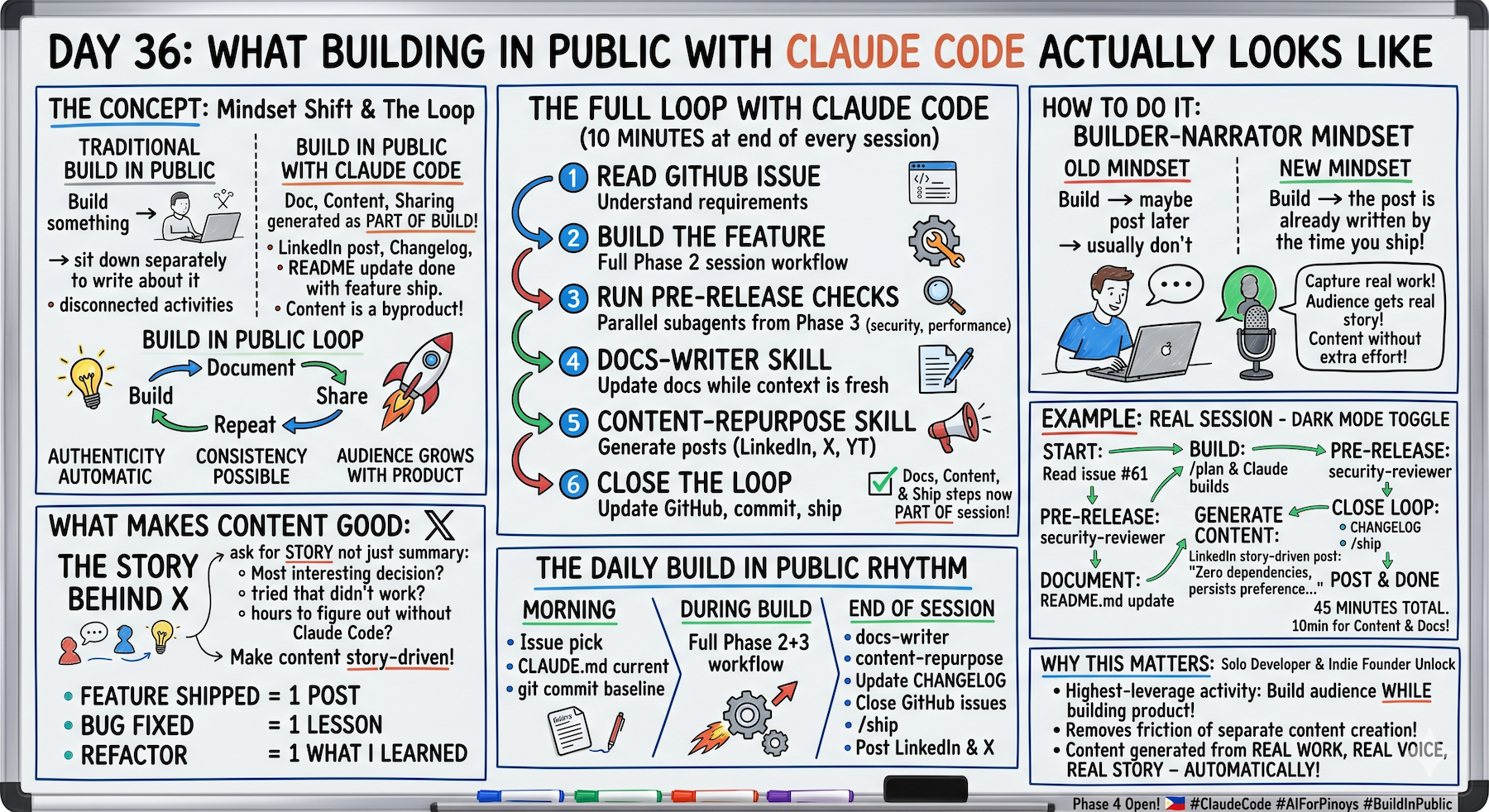
The Build In Public Loop
Traditional loop:
Build → Document → Share → Repeat
Each phase feeds the next.
The build produces real work.
Documentation captures it accurately.
Sharing grows the audience that cares about the next build.
With Claude Code the loop looks like:
1. Read the GitHub issue — understand what you're building
2. Build the feature — full session workflow from Phase 2
3. Run pre-release checks — parallel subagents from Phase 3
4. Document what shipped — docs-writer skill
5. Generate content — content-repurpose skill
6. Close the loop — update GitHub, commit, ship
Steps 4, 5, and 6 used to happen separately — if at all.
Now they're the last 10 minutes of every build session.
The Mindset Shift (Builder to Builder-Narrator)
Old mindset:
Build → maybe post about it later → usually don't
New mindset:
Build → the post is already written by the time you ship
This isn't about performing work for an audience.
It's about capturing real work accurately and sharing it while it's fresh.
The audience gets the real story.
You get the content without extra effort.
The Full Build In Public Loop in Practice
cd ~/projects/my-app
claude
Step 1: Start With the Real Task
Read GitHub issue #61.
Summarize what we're building before we start.
Real issue. Real context. Real work ahead.
Step 2: Build It
/plan
Approve the plan.
Claude builds.
Step 3: Pre-Release Checks
Run security-reviewer and performance-reviewer
on the new files simultaneously.

Findings under 100 words each.
Parallel subagents from Phase 3.
Quality check before shipping.
Step 4: Document While Context Is Fresh
Use the docs-writer skill to update the relevant
docs for what we just built.

Read the new files before writing.
Show me the diff.
docs-writer skill reads actual code.
Generates accurate documentation.
Shows diff for approval.
Step 5: Generate Content
Use the content-repurpose skill to turn this
feature into content.

Reference what the feature does, why it matters,
and what I learned building it.

Generate: LinkedIn post, X post, YouTube Community post.
content-repurpose skill applies your voice.
Platform-specific rules.
Ready-to-post content.
Step 6: Close the Loop
Update CHANGELOG.md with what shipped.
Close GitHub issue #61 with a comment.
/ship
GitHub updated via MCP.
Changelog current.
Shipped.
Feature built. Docs updated. Content generated. Issue closed.
All in one session.
What Makes Build In Public Content Good
The content that resonates isn't "I built X today."
It's the story behind X.
What was hard?
What surprised you?
What did you learn?
Claude Code gives you the raw material because it was there for the whole build.
After a Session, Ask for the Story
claude
What was the most interesting technical decision
we made in this session?

What did we try that didn't work before we got it right?

What would have taken hours to figure out without
Claude Code?

Use those answers to make the content-repurpose
output more story-driven — not just a feature announcement.
That's the difference between:
"Added dark mode toggle today ✅"
And:
"Dark mode isn't a feature. It's a promise that you respect how people want to use your product. Here's what I learned shipping it in one session..."
Story-driven content gets engagement.
Feature announcements get ignored.
Your Daily Build In Public Rhythm
Morning
- Pick the issue to work on
- Check CLAUDE.md is current
- git commit baseline
During Build
- Full Phase 2 + 3 workflow
Build like you learned in Phases 1-3.
No changes to the work itself.
End of Session (10 Minutes)
- docs-writer skill → update docs
- content-repurpose skill → generate posts
- Update CHANGELOG
- Close GitHub issues
- /ship
- Post the LinkedIn and X content
Optional
- /standup → your end-of-day summary
10 minutes added to the end of every session.
That's the only difference.
The Build In Public Content Calendar (It Writes Itself)
Every feature shipped = 1 LinkedIn post + 1 X post
Every bug fixed = 1 lesson post
Every refactor = 1 "what I learned" post
Every phase wrap-up = 1 milestone post
Every 10 days = 1 "here's what I've built" recap
If you ship three features a week — you have three posts.
If you fix two bugs — two more.
The content is the work. The work is the content.
Complete Real Session Example
Real Build In Public session from start to finish.
The Issue
cd ~/projects/my-app
claude
Read GitHub issue #61 — "Add dark mode toggle"
What are we building?
Claude reads issue via GitHub MCP:
Dark mode toggle in navbar
Persists to localStorage
Respects system preference
Confirmed. Ready to build.
The Build
/plan
Plan approved.
Claude builds dark mode toggle.
Component created. State management. Persistence. System preference detection.
Done.
Pre-Release Check
Run security-reviewer on the new files.
Any issues?
Clean. No findings.
Documentation
Use the docs-writer skill to update README.md
with the dark mode feature.

One paragraph, user-facing language.
docs-writer skill updates README:
## Dark Mode

Toggle between light and dark themes from the navbar.
Your preference is saved automatically and respected
across sessions. The app also detects your system
theme preference on first visit.
Accurate. User-friendly. Done.
Content Generation
Use the content-repurpose skill.

Feature: dark mode toggle — persists preference,
respects system setting, zero dependencies.

Make the LinkedIn post story-driven:
What problem does this solve for users?
What was the most interesting part of building it?
What did Claude Code handle that would have
taken me an hour manually?
content-repurpose skill generates:
LinkedIn Post
Dark mode isn't a feature.

It's a promise that you respect how people want
to use your product.

Shipped it today in one session.

The interesting part? Making it respect system
preference while still letting users override.

Most apps pick one or the other.

We do both — if you've never set a preference,
we match your system. Once you toggle, we remember.

Claude Code handled the localStorage sync, the
system preference detection, and the state management
across components.

What would have taken me an hour of debugging
weird edge cases? Done in 20 minutes.

Zero dependencies. Just clean React state.

Feature shipped. Users happy. On to the next one.

Read how we're building: giangallegos.com
X Post
Dark mode shipped ✅

Not just a toggle — respects system preference
AND remembers your choice.

Most apps pick one. We do both.

Claude Code handled the localStorage + system
detection edge cases in 20 min.

Zero dependencies. Just clean state.

#BuildInPublic #ClaudeCode
Story-driven. Real details. Lesson embedded.
Ready to post.
Close the Loop
Update CHANGELOG.md — "Added dark mode toggle (#61)"
Close issue #61: "Shipped — dark mode live"
/ship
Changelog updated.
Issue closed via GitHub MCP.
Shipped.
Post the Content
Copy LinkedIn post. Paste. Post.
Copy X post. Paste. Post.
Done.
The Timeline
Total session: 45 minutes
- Build: 25 minutes
- Pre-release check: 5 minutes
- Documentation: 5 minutes
- Content generation: 5 minutes
- Close loop + ship: 5 minutes
Feature shipped. Docs updated. Content posted. Issue closed.
10 of those 45 minutes were documentation and content.
Without Claude Code? Those 10 minutes would be separate. Later. Probably never.
Why This Matters
Building in public is one of the highest-leverage things a solo developer or indie founder can do.
It builds an audience while you build the product.
The reason most developers don't do it consistently?
The friction of content creation on top of already demanding build work.
Claude Code removes that friction.
The content is generated from the real work.
In the real voice.
With the real story.
Automatically, at the end of every session.
That's the Build In Public unlock Phase 4 is about.
My Raw Notes (Unfiltered)
The shift that clicked for me: the content isn't separate from the work anymore.
By the time I close a GitHub issue the LinkedIn post is already written.
That's a fundamentally different relationship with building in public than trying to remember what I built and write about it later.
The story-driven content prompt is the one that makes the difference between posts that get engagement and posts that get ignored.
Asking Claude what was interesting or surprising about the session produces real content — not just feature announcements.
The daily rhythm feels sustainable in a way posting never did before because it adds 10 minutes to a session that was already happening.
Phase 4 Is Open
This is the new normal.
Every feature ships with a story.
Every build session ends with content.
The product and the audience grow together.
Following this live:
Every feature I ship from now on gets documented here.
Real builds. Real stories. Real lessons.
No highlight reel. Just the actual work.
What's Next
Day 37 preview:
Documenting Your Claude Code Workflow As You Ship — how to capture your process in real time so your content is always accurate and your audience always learns something real.
Following This Series
Core 30 Days: ✅ Complete
Bonus Days: In progress
Phase 1 (Days 1-7): Foundations ✅ Complete
Phase 2 (Days 8-21): Getting Productive ✅ Complete
Phase 3 (Days 22-35): Power User ✅ Complete
Phase 4 (Days 36+): Build In Public ⬅️ You are here
G
P.S. - The mindset shift: Build → the post is already written by the time you ship. That's different from Build → maybe post later → usually don't.
P.P.S. - What makes content good: ask Claude what was interesting or surprising about the session. Story-driven content gets engagement. Feature announcements get ignored.
P.P.P.S. - The daily rhythm: 10 minutes at the end of every session. docs-writer skill, content-repurpose skill, update CHANGELOG, close issues, /ship, post. Sustainable because it's part of the session, not separate work.