Day 44: Claude Code for Solo Founders - Shipping Faster With a One-Person Team
Most Claude Code content is aimed at developers on teams. But a lot of people following this series are solo founders running everything themselves. This changes how you use it.

Hey, it's G.
Day 44 of the Claude Code series.
Most tutorials assume you're part of a team. Someone else handles the designs. Someone else writes the docs. Someone else deals with user support while you code.
But a lot of you reading this are solo. You're the designer, developer, product manager, content creator, and support team. All at once. From a cluttered desk with a laggy laptop.
Today's about how Claude Code changes the game specifically for that context.
Not just coding faster. Operating differently.
The Core Problem (Why Solo Is Different)
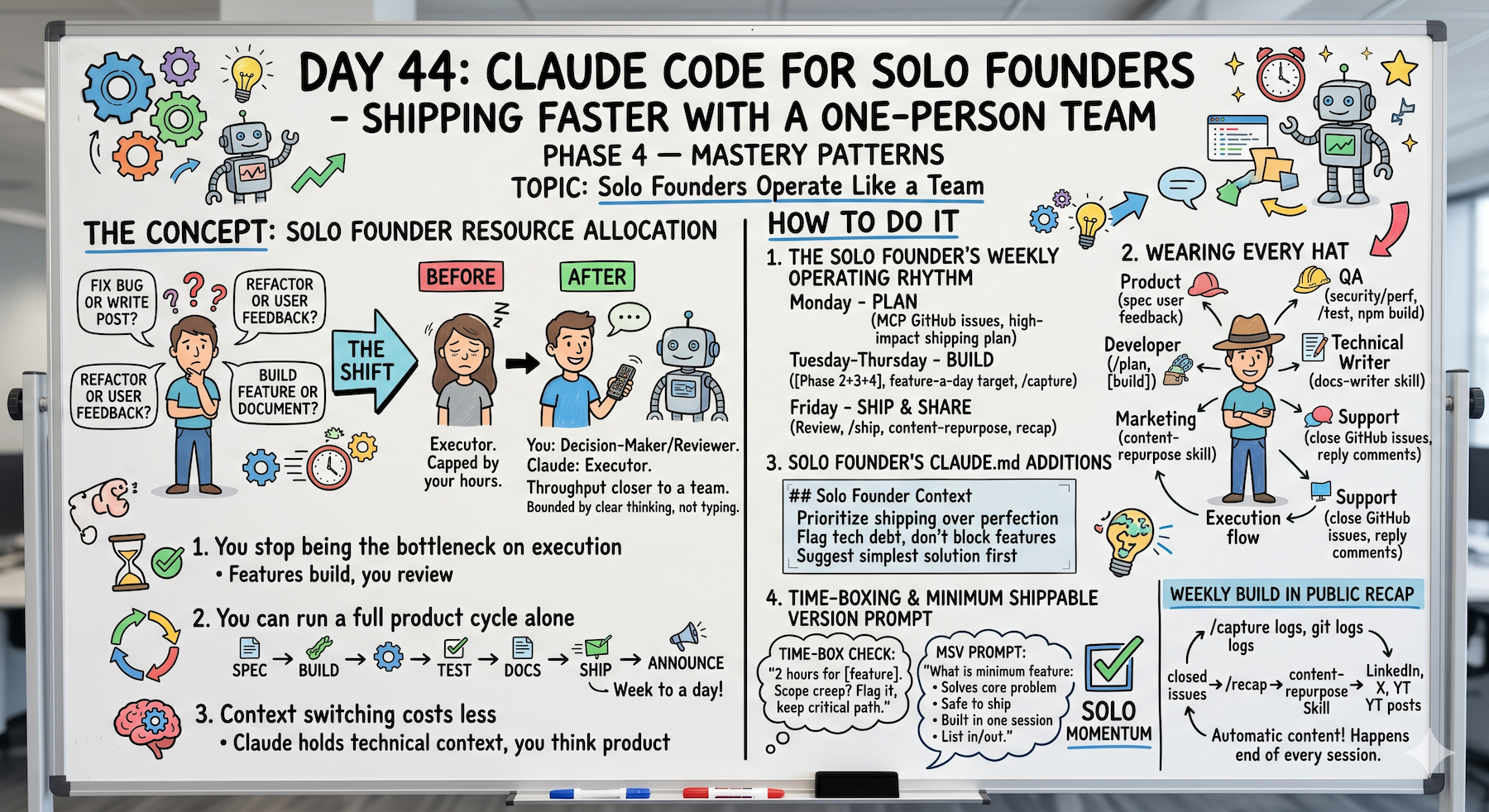
Being a solo founder means every hour is a resource allocation decision.
Do you fix the bug or write the marketing post?
Do you refactor the code or respond to user feedback?
Do you build the next feature or document the last one?
There's never enough time. And every task you choose means three other tasks don't get done.
Claude Code doesn't eliminate those decisions.
But it compresses the time cost of each one so dramatically that you can do more of them in the same day without the quality dropping.
The Shift (What Actually Changes)
Before Claude Code:
You are the only executor. Every task you want done, you have to do yourself. Your throughput is capped by your hours.
After Claude Code:
You are the decision-maker and the reviewer. Claude Code is the executor. Your throughput is now closer to a small team — bounded not by how fast you can type but by how clearly you can think.
This creates a different way of working. Not faster coding. A different role entirely.
Three things that change for solo founders specifically:
1. You Stop Being the Bottleneck on Execution
Features get built while you're reviewing the previous one.
Tests get written automatically.
Documentation happens at the end of every session.
Work that used to wait for you no longer waits.
2. You Can Run a Full Product Cycle Alone
Idea → spec → build → test → document → ship → announce.
Every step has a Claude Code workflow.
A full product cycle that used to take a week can happen in a day.
3. Context Switching Costs Less
The hardest part of solo work is context switching — from deep code to writing to strategy and back.
Claude Code holds the technical context so you can step out of the code brain and into the product brain without losing your place.
When you come back, Claude remembers where you were. You don't have to reload your entire mental model from scratch.
The Solo Founder's Weekly Operating Rhythm
Here's the structure that actually works for me:
Monday — Plan
> Read all open GitHub issues via MCP.
> What's the highest-impact thing to ship this week?
> Suggest a priority order based on user impact and effort.
> Output a one-week plan I can actually execute.
Claude reads the real issues. Not a todo list you wrote three weeks ago and forgot about. The actual current state.
Tuesday-Thursday — Build
One feature per day target.
Full workflow from Phase 2 + 3 + 4./capture at the end of every session.
Friday — Ship and Share
Review everything built this week./ship on anything ready.
Use content-repurpose skill on the week's work.
Post the weekly Build In Public recap.
This rhythm keeps you from the two most common solo founder traps:
- Building for weeks without shipping anything
- Shipping constantly but never building anything substantial
One week. Clear input (Monday plan). Clear output (Friday ship).
Wearing Every Hat (Without Losing Your Mind)
The solo founder advantage with Claude Code is that you can move between roles without losing context.
Product hat — spec from user feedback:
> Read all GitHub issues labeled "user-feedback" via MCP.
> Group by theme. Identify the top 3 pain points.
> Write a one-paragraph spec for the feature that
> would solve the most common pain.
Developer hat — build it:
> /plan
> [approve]
> [build]
QA hat — review and test:
> Run security-reviewer and performance-reviewer.
> /test on all new files.
> Run npm run build and typecheck.
Technical writer hat — document it:
> Use docs-writer skill to update docs.
Marketing hat — announce it:
> Use content-repurpose skill.
> LinkedIn, Reddit, X, YouTube Community.
Support hat — close the loop:
> Close the GitHub issues this feature resolves.
> Reply to any issue comments mentioning this feature.
Every role. One session. No manual context switching.
The Minimum Shippable Version Prompt (Your Best Friend)
One of the hardest parts of solo work is scope creep.
A two-hour task becomes a six-hour task because you kept "improving" it.
This prompt contains it every time:
> I want to ship [feature] today.
> What is the minimum version of this feature that:
> - Solves the core user problem
> - Is safe to ship without embarrassing bugs
> - Can be built in one session
>
> List what's in and what's explicitly out of scope.
> I'll build the full version later — today I ship something.
Claude scopes it for you.
In scope: export current table view as CSV, download triggers immediately
Out of scope: custom column selection, scheduled exports, large dataset handling (defer to v2)
You ship the thing that matters today. V2 can wait.
This is the prompt I use most as a solo founder. More than any other.
Time-Boxing (So Sessions Don't Spiral)
Solo work has no natural boundaries. No standup tomorrow. No code review waiting. Just you and the work.
That's dangerous. Sessions spiral into six-hour marathons that leave you burned out.
Claude Code helps contain it:
> I have 2 hours for this session.
> The goal is to ship [feature].
> If we hit scope that would exceed 2 hours —
> flag it and suggest what to cut or defer.
> Keep me on the critical path.
Mid-session scope check:
> We're an hour in. Are we on track to finish
> [feature] in the remaining hour?
> What's left and is it realistic?
> If not — what's the minimum shippable version?
This keeps you honest. And keeps you from burning out.
Handling User Feedback Mid-Build (Without Losing Momentum)
The worst interruption: you're deep in building Feature A, and a user reports a critical bug in Feature B.
Do you context-switch? Do you ignore it? Do you panic?
Claude Code makes the triage decision clean:
> A user just reported: [paste feedback]
> I'm currently mid-session on [feature].
>
> Quick assessment:
> - Is this a bug that blocks users right now?
> - Is this related to what I'm currently building?
> - Can it wait until I finish today's session?
>
> Recommend: fix now, fix at end of session, or
> create a GitHub issue and fix later.
If it's urgent, context-switch cleanly:
> Save where we are on [current feature].
> Write a brief context note so we can resume later:
> - What was built
> - What's left to do
> - What file to look at first when we resume
>
> Then let's fix the user issue.
Fix the blocker. Come back to the feature. No mental overhead lost.
The Weekly Build In Public Recap (Writes Itself)
Every Friday:
> Read this week's session logs from /docs/sessions/.
> Read the git log for this week.
> Read GitHub issues closed this week via MCP.
>
> Write a weekly Build In Public recap covering:
> - What shipped this week
> - One key technical lesson from the builds
> - What's planned for next week
> - One honest reflection on what was hard
>
> Use the content-repurpose skill to turn it into:
> LinkedIn post, X thread, YouTube Community post.
Your content marketing happens automatically from the work you already did.
No "what should I post this week?" stress. Just ship code. Claude turns it into content.
Real Example (One Week, Three Features, Solo)
Monday planning session:
> Read all open GitHub issues via MCP.
> I have 3 build days this week.
> What are the 3 highest-impact issues to ship?
> Consider: user impact, revenue impact, effort estimate.
> Output a Mon-Fri plan.
Claude reads real issues and recommends:
- Tuesday: Issue #71 — fix broken email confirmation (blocking new signups — critical)
- Wednesday: Issue #64 — add CSV export (most requested feature — high impact)
- Thursday: Issue #58 — improve onboarding flow (affects conversion — medium impact)
- Friday: ship all three + weekly recap
Tuesday — fix the blocker:
> Issue #71 is blocking new signups.
> This is the only thing that matters today.
> /plan for the email confirmation fix.

> What is the minimum fix that unblocks signups?
> No refactoring. No cleanup. Just the fix.
Build. Fix. Test. Ship. Close issue #71.
Wednesday — CSV export:
> Issue #64 — CSV export.
> I have one session for this.
> What is the minimum shippable version?
Claude scopes it. Build. Test. Document. Ship.
Friday — recap:
> Read this week's session logs.
> Read git log for this week.
> Write weekly Build In Public recap.
> Use content-repurpose skill.
Three features. One week. Solo. Shipped and documented.
That's the rhythm.
The Solo Founder's CLAUDE.md Additions
Add this to your CLAUDE.md:
## Solo Founder Context

I am a solo founder — I am the only developer,
product manager, and content creator on this project.

This means:
- Prioritize shipping over perfection
- Flag technical debt but don't let it block features
- Suggest the simplest solution that works first
- If a task would take more than one session —
  break it into shippable pieces and suggest the order

## Weekly Rhythm
- Monday: planning session
- Tue-Thu: build sessions
- Friday: ship and content session

## Priorities in order:
1. Unblock paying users (bugs affecting revenue)
2. Ship features users asked for
3. Technical improvements
4. Documentation
Claude knows you're solo. It adapts.
Why This Actually Matters
Solo founders are the developers who benefit most from Claude Code — and the ones most likely to underuse it because they're too busy executing to step back and build the system.
The irony is that spending two hours setting up the system from this series saves twenty hours a week of manual execution.
The compounding effect is real:
- Every session builds on the last
- Every skill added makes future output better
- Every command saved removes future friction
A solo founder with a complete Claude Code system is not operating alone.
They're operating with infrastructure that multiplies their output without multiplying their hours.
That's the unlock.
My Raw Notes (Unfiltered)
The minimum shippable version prompt is the one I use most as a solo founder. Scope creep is the thing that kills momentum more than anything else and having Claude explicitly scope what's in and out before building keeps sessions focused.
The Monday planning session from GitHub issues is something I now do every week without exception — reading real user feedback before deciding what to build keeps me from building the wrong thing fast.
The context-switch cleanly prompt when user feedback lands mid-build is underrated — it gives me permission to pause without losing my place.
The weekly recap that writes itself from session logs is the Build In Public habit that finally became consistent for me.
Tomorrow (Day 45 Preview)
Topic: Claude Code + Your Existing Tools — Supabase, Firebase, Vercel, and how to make Claude Code work seamlessly with the stack you already use.
What I'm testing: Integration workflows, deployment automation, and whether Claude can manage your entire stack from the terminal.
Following This Series
Daily updates for 30 days. Each day builds on the last.
So far we've covered setup, prompting, file systems, terminal commands, CLAUDE.md, planning workflows, testing, multi-agent systems, and now solo founder operations.
Day 45 tomorrow: Stack integration.
G
P.S. - You're not operating alone. You're operating with infrastructure.
P.P.S. - If you're a solo founder using Claude Code, what's your weekly rhythm? Drop it in the comments. I want to learn from people who've built sustainable solo systems.
P.P.P.S. - The two-hour setup that saves twenty hours a week is real. But you have to actually do the two hours. Don't skip the system-building.