Day 47: Where Claude Code Is Going - And What 47 Days Actually Built
47 days ago I started this series as someone who had already shipped two apps with Claude Code without really understanding it. Today I'm finishing it with a complete system.
Hey, it's G.
Day 47 of the Claude Code series.
The final lesson.
This one's different. It's not about a feature or a workflow or a technique.
It's a reflection. A forward look. And a letter to the version of me who started this series 47 days ago without knowing what he was building.
The Beginning (Day 1 Me)
When I started this series, I had already shipped Resiboko and 1MinThumb using Claude Code.
I thought I knew how it worked because I got results.
I didn't.
I was vibing my way through it. No CLAUDE.md. No slash commands. No system. Just raw prompting and copy-pasting code into files and hoping it worked.
It worked — but inefficiently. Every session started from zero context. Every project rebuilt the same setup from scratch. Every workflow reinvented the same steps.
I was getting results. But I was leaving most of the power on the table.
Day 1 was deciding to learn it properly. To document everything I learned. To share it daily with the AI For Pinoys community.
47 days later — this is what that decision produced.
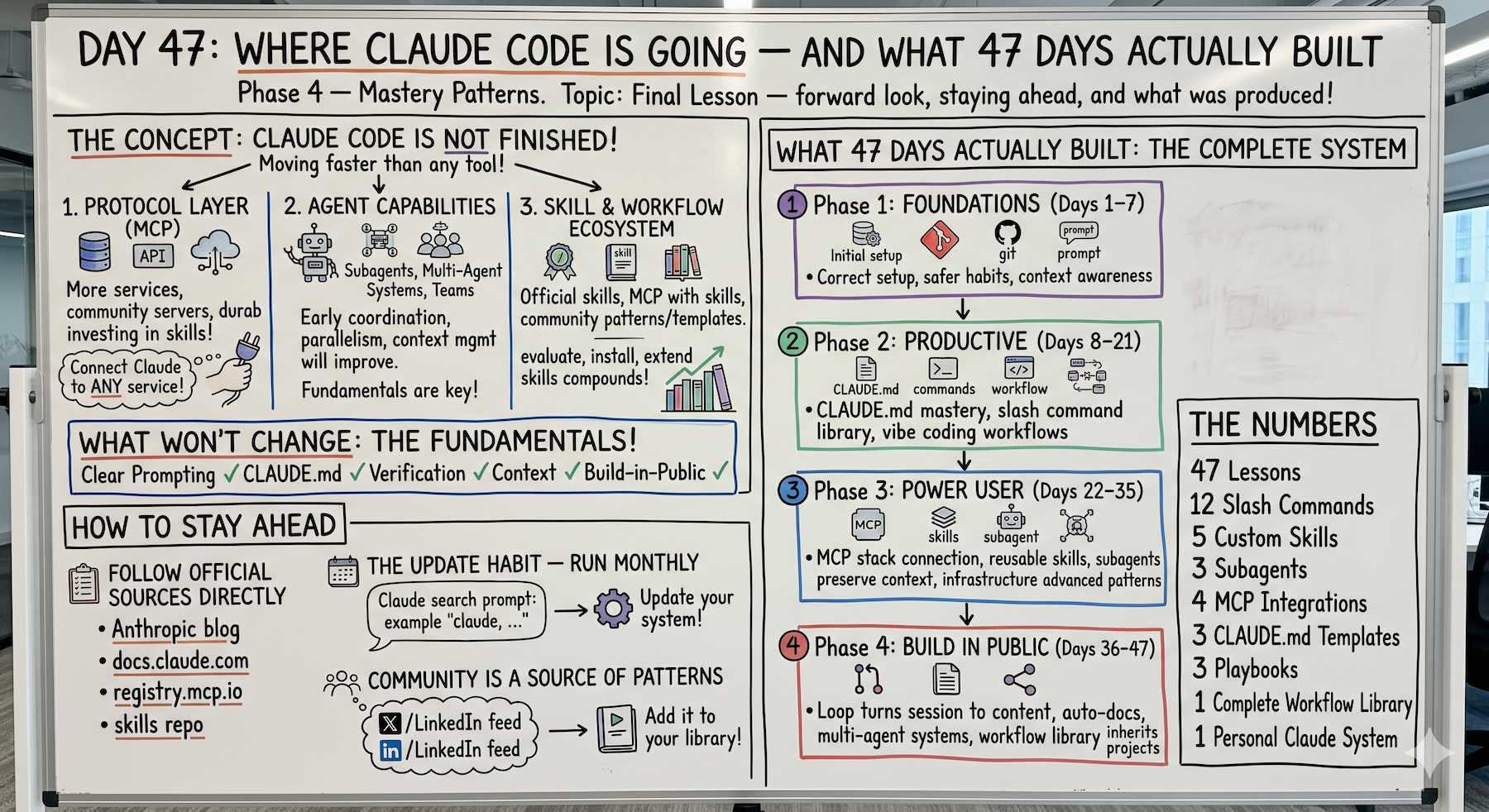
What 47 Days Actually Built
The complete system:
Phase 1 — Foundations (Days 1-7)
What Claude Code is and how to set it up correctly. The habits that make every session safer and faster.
Phase 2 — Getting Productive (Days 8-21)
CLAUDE.md mastery — not just writing it but making it work. A slash command library that removes repeated friction. Vibe coding workflows for every situation you'll encounter.
Phase 3 — Power User (Days 22-35)
MCP integrations that connect Claude Code to your entire stack. Skills that package your workflows for permanent reuse. Subagents that parallelize work and preserve context. Advanced patterns that combine all three into infrastructure.
Phase 4 — Build In Public (Days 36-47)
The Build In Public loop that turns every session into content. Real-time documentation that happens automatically. A personal system that lives on every machine. A workflow library that every future project inherits. Multi-agent systems for work too complex for one session. Mastery patterns for solo founders and full-stack teams.
The numbers:
- 47 lessons
- 12 slash commands
- 5 custom skills
- 3 specialized subagents
- 4 MCP server integrations
- 3 CLAUDE.md templates
- 3 core playbooks
- 1 complete workflow library
- 1 personal Claude Code system versioned in git
Not just knowledge. Infrastructure.
What Changed (From Day 1 to Day 47)
Day 1 workflow:
New project. Start Claude Code. Explain what the project is. Explain the tech stack. Explain the coding conventions. Give context about what I'm building.
Every session. Every project. From scratch.
Day 47 workflow:
New project. Copy CLAUDE.md template. Fill in three placeholders. Run /new-project-setup playbook.
9 minutes. Full system active. Claude knows everything.
Every slash command ready. Every skill available. Every subagent configured. Every MCP connection live.
The project inherits 47 days of learning before the first line of code is written.
That's the difference.
Day 1 feature build:
Prompt Claude to build a feature. Copy code. Paste into files. Test manually. Fix bugs. Repeat. Ship when it seems to work. Hope nothing breaks in production.
Day 47 feature build:
Read GitHub issue via MCP. Run /plan. Orchestrator assigns workers. API agent builds backend. Frontend agent builds UI. Test agent writes tests. Security reviewer flags issues. Fix. Pre-deploy checklist runs. All checks pass. Ship. Session log becomes content automatically.
Clean. Systematic. Nothing skipped.
Day 1 debugging:
Something breaks. Read error. Ask Claude. Get suggestions. Try them. Maybe they work. Maybe they don't. Repeat until fixed.
Day 47 debugging:
Something breaks. Run /debug. Claude reads stack trace. Checks RLS policies. Checks environment variables. Checks edge runtime restrictions. Diagnoses across entire stack — not just code. Presents root cause. Shows fix. Runs verification. Ships with regression test.
Infrastructure-level debugging. Not guesswork.
Where Claude Code Is Going (And How to Stay Ahead)
Claude Code is not finished.
It's moving faster than almost any developer tool in history.
The features that felt advanced in Phase 3 — MCP, skills, subagents, multi-agent systems — were either brand new or significantly upgraded in the time it took to write this series.
Three things that will keep changing:
1. The Protocol Layer (MCP) Will Keep Expanding
More services will publish official MCP servers. The ones that don't will have community servers built for them.
The pattern of "connect Claude Code to any external service" will become as normal as npm packages are today.
Your skill at configuring and using MCP servers is a durable investment.
2. The Agent Capabilities Will Keep Improving
Subagents, multi-agent systems, and agent teams are early.
The coordination patterns. The parallelism. The context management. All of these will get better.
The developers who understand the fundamentals of agent design today will be the ones who use tomorrow's improvements most effectively.
3. The Skill and Workflow Ecosystem Will Grow
More official skills will ship. More companies will publish MCP servers with companion skills. The community will contribute patterns, templates, and libraries.
Your ability to evaluate, install, and extend skills is a skill that compounds with every new addition to the ecosystem.
What won't change: the fundamentals.
Clear prompting.
Good CLAUDE.md discipline.
Verification habits.
Context management.
The Build In Public loop.
These were useful on Day 1 and they'll be useful when Claude Code looks completely different from how it looks today.
How To Stay Ahead (The Practical System)
Follow the official sources — directly:
- Anthropic blog: anthropic.com/news
- Claude Code docs: docs.claude.com/en/docs/claude-code
- MCP registry: registry.modelcontextprotocol.io
- Skills repo: github.com/anthropics/skills
The update habit — run this monthly:
claude
> I want to stay current with Claude Code.
> Search for any major Claude Code updates or
> new features announced in the last 30 days.
> Summarize what's new and whether any of it
> changes how I should be using Claude Code.
> Flag anything that would update my workflow library.
Update your system when the tool updates:
# After a significant Claude Code update:
> Read the release notes for Claude Code [version].
> Compare against my current workflow library.
> What should I update, add, or change in:
> - My CLAUDE.md templates
> - My slash commands
> - My skills
> - My subagent definitions
> - My playbooks
>
> Suggest specific updates — not general advice.
The community is a source of patterns:
The developers building in public with Claude Code are discovering patterns daily.
Follow the build-in-public community on X and LinkedIn.
When someone shares a workflow that solves a problem you have — extract the pattern and add it to your library.
# When you find a good pattern from the community:
> I found this workflow from another developer:
> [paste the pattern]
>
> Evaluate it:
> - Does it apply to my stack?
> - Is it better than what I currently do?
> - How would I adapt it for my conventions?
>
> If worth keeping — add it to the right playbook.
Stay curious. Stay systematic. The fundamentals compound.
Why This Matters (The Bigger Picture)
47 days is a commitment.
Most developers use Claude Code the way they used the first IDE they ever opened — intuitively, without reading the manual, getting some results but leaving most of the power unused.
This series was the manual.
Not Anthropic's manual — a practitioner's manual, written in real time, by someone building real products with the tool every day.
The community that followed this series didn't just learn Claude Code.
They built a system. Developed habits. Joined a conversation about how Filipino developers can use AI tools to build world-class products from Manila.
That's what 47 days actually built.
Not just a better way to code. A better way to build.
My Raw Notes (Unfiltered)
Writing Day 47 felt different from every other day. Not because the lesson is harder but because it closes something.
The letter to Day 1 version of me is the most honest thing in the whole series — I really did ship two apps without understanding the tool properly. The series fixed that and then built something much bigger.
The thing I'm most proud of is the workflow library — it means the next project I start gets the benefit of 47 days of learning before a single line of code is written.
Staying ahead of Claude Code going forward is really just about maintaining the system and staying curious — the fundamentals don't change even when the features do.
To Everyone Who Followed Along
Thank you.
47 daily lessons. One complete system. Built in public, for the Filipino developer community.
This series is done. The building continues.
The Complete Series — All 47 Days
Phase 1 — Foundations (Days 1–7)
Day 1: What Claude Code is and how to set it up
Day 2: How to prompt Claude Code effectively
Day 3: CLAUDE.md — your permanent briefing
Day 4: What Claude Code can see in your project
Day 5: Running terminal commands
Day 6: Reading and writing files safely
Day 7: Your complete setup checklist
Phase 2 — Getting Productive (Days 8–21)
Day 8: CLAUDE.md structure and sections
Day 9: Writing rules Claude actually follows
Day 10: Evolving your CLAUDE.md over time
Day 11: Your first slash command
Day 12: Building your slash command library
Day 13: Advanced slash commands
Day 14: What vibe coding actually is
Day 15: Feature-first workflow
Day 16: Debugging with Claude Code
Day 17: Refactoring with Claude Code
Day 18: Writing tests with Claude Code
Day 19: Working with APIs
Day 20: Multi-file workflows
Day 21: Phase 2 wrap-up
Phase 3 — Power User (Days 22–35)
Day 22: What MCP is and why it matters
Day 23: Setting up your first MCP server
Day 24: MCP in practice
Day 25: Building your own MCP server
Day 26: What Claude Skills are
Day 27: Installing existing skills
Day 28: Writing your first custom skill
Day 29: What subagents are
Day 30: Your first subagent workflow
Day 31: Subagent patterns
Day 32: Combining MCP + Skills + Subagents
Day 33: Claude Code for non-coding tasks
Day 34: Debugging complex workflows
Day 35: Phase 3 wrap-up
Phase 4 — Build In Public (Days 36–47)
Day 36: What building in public looks like
Day 37: Documenting your workflow as you ship
Day 38: Sharing your setup with your community
Day 39: Building your personal Claude Code system
Day 40: Designing a multi-agent system
Day 41: The orchestrator + worker pattern
Day 42: Multi-agent for real projects
Day 43: Multi-agent failure modes
Day 44: Claude Code for solo founders
Day 45: Claude Code + your existing tools
Day 46: Building your workflow library
Day 47: Where Claude Code is going
The series is complete. 🎉
47 days. 4 phases. One complete system.
The AI For Pinoys community now has the most complete Claude Code curriculum in the Filipino developer ecosystem — written from real experience, in real voice, with real workflows.
Go build something great. 🇵🇭
G
P.S. - The full archive lives at giangallegos.com. Every lesson. Every workflow. Every template. All documented.
P.P.S. - If this series helped you build something, let me know. That's what makes the 47 days worth it.
P.P.P.S. - This series is done. But the conversation continues. AI For Pinoys is just getting started.